
Connect with us

Marin County

Empire, Wyoming: A Short-Lived Community

Published

on

Tamara Shiloh

Wyoming seemed an unlikely place for African Americans to build a community, especially at the turn of the 20th century. At that time, Blacks were considered an “isolated minority.” In fact, only 65 out of 10,915 farms in the state were owned by “Negro and other non-white farmers,” according to a June 1911 Cheyenne State Leader report.

Such statistics suggest that little African-American history is expected to be uncovered in a place like Wyoming, yet people of color have contributed to its culture since before the Cowboy State was a state. Among them were Charles and Rosetta Speese, and three of Charles’ brothers, John, Joseph and Radford, who, after migrating from Nebraska, founded the community of Empire in 1908.

The family purchased about 800 acres of land on the Nebraska-Wyoming state line near Torrington, Wyo. This was the land that became Empire.

The settlement quickly populated with successful, forward-thinking Blacks, burgeoning into a powerful community. A public school was established in 1909; in 1911, an ordained Presbyterian minister and teacher arrived, becoming the community’s leader as a teacher, preacher and postmaster.

The post office was established in 1912, followed in 1916 by a new larger building for the already-established Grace Presbyterian Church. Although it was an all-Black community, all establishments in Empire were open to the general public with no regard to race despite segregation and miscegenation laws.

At this point, the settlement’s population had reached about 50 citizens. At its peak, it would boast 65 Black-owned farms. However, because of Empire’s positive contribution to the state, and being on the heels of an ongoing economic heyday, racism reared its ugly head.

The Black community was immediately blamed for any mishaps or missing items. Torrington courts were prejudiced, siding with the white community. This spurred John Speese to become an attorney for Empire’s citizens.

From 1904 to 1920, five Black men were lynched in Wyoming. One of the worst of these was Baseman Taylor in 1913.

Taylor had become paranoid and threatening, prompting his family to commit him to the Wyoming Hospital for the Insane. Baseman did not resist when taken into custody, yet the Goshen County sheriff used excessive force resulting in Baseman’s head injury. Almost immediately, Baseman suffered seizures.

With no jail in the new county, prisoners were held at the Torrington Hotel. There, Baseman was shackled to a bed where other prisoners and hotel guests witnessed him beaten, burned, choked, pinched and abused. He died at the hotel after three days of torture by law enforcement. His death went on record as a preexisting medical condition.

Blacks in Empire came to the realization that the securing of civil rights, safety and security and freedom from racism that they sought did not exist. By 1920, the population declined to 23. By 1930, only four Blacks remained in Empire.

Today the nameless grave of an infant is among scant traces left of Empire. A plaque reads: “Afro American” at the foot of the metal pipe cross, 40 yards beyond the rural cemetery fence.

Tamara Shiloh

Tamara Shiloh


About Tamara Shiloh


Tamara Shiloh has published the first two books in her historical fiction chapter book series, Just Imagine…What If There Were No Black People in the World is about African American inventors, scientists and other notable Black people in history. The two books are Jaxon’s Magical Adventure with Black Inventors and Scientists and Jaxon and Kevin’s Black History Trip Downtown. Tamara Shiloh has also written a book a picture book for Scholastic, Cameron Teaches Black History, that will be available in June, 2022.

Tamara Shiloh’s other writing experiences include: writing the Black History column for the Post Newspaper in the Bay area, Creator and Instruction of the black History Class for Educators a professional development class for teachers and her non-profit offers a free Black History literacy/STEM/Podcast class for kids 3d – 8th grade which also includes the Let’s Go Learn Reading and Essence and tutorial program.   She is also the owner of the Multicultural Bookstore and Gifts, in Richmond, California,

Previously in her early life she was the /Editor-in-Chief of Desert Diamonds Magazine, highlighting the accomplishments of minority women in Nevada; assisting with the creation, design and writing of a Los Angeles-based, herbal magazine entitled Herbal Essence; editorial contribution to Homes of Color; Editor-in-Chief of Black Insight Magazine, the first digital, interactive magazine for African Americans; profile creations for sports figures on the now defunct PublicFigure.com; newsletters for various businesses and organizations; and her own Las Vegas community newsletter, Tween Time News, a monthly publication highlighting music entertainment in the various venues of Las Vegas.

She is a member of:

  • Society of Children’s Book Writers and Illustrators (SCBWI)

  • Richmond Chamber of Commerce

  • Point Richmond Business Association

  • National Association of Professional Women (NAPW)

  • Independent Book Publishers Association (IPBA)

  • California Writers Club-Berkeley & Marin

  • Richmond CA Kiwanis

  • Richmond CA Rotary

  • Bay Area Girls Club


Tamara Shiloh, a native of Northern California, has two adult children, one grandson and four great-grand sons. She resides in Point Richmond, CA with her husband, Ernest.

www.multiculturalbookstore.com

About Tamara Shiloh

Tamara Shiloh has published the first two books in her historical fiction chapter book series, Just Imagine…What If There Were No Black People in the World is about African American inventors, scientists and other notable Black people in history. The two books are Jaxon’s Magical Adventure with Black Inventors and Scientists and Jaxon and Kevin’s Black History Trip Downtown. Tamara Shiloh has also written a book a picture book for Scholastic, Cameron Teaches Black History, that will be available in June, 2022. Tamara Shiloh’s other writing experiences include: writing the Black History column for the Post Newspaper in the Bay area, Creator and Instruction of the black History Class for Educators a professional development class for teachers and her non-profit offers a free Black History literacy/STEM/Podcast class for kids 3d – 8th grade which also includes the Let’s Go Learn Reading and Essence and tutorial program.   She is also the owner of the Multicultural Bookstore and Gifts, in Richmond, California, Previously in her early life she was the /Editor-in-Chief of Desert Diamonds Magazine, highlighting the accomplishments of minority women in Nevada; assisting with the creation, design and writing of a Los Angeles-based, herbal magazine entitled Herbal Essence; editorial contribution to Homes of Color; Editor-in-Chief of Black Insight Magazine, the first digital, interactive magazine for African Americans; profile creations for sports figures on the now defunct PublicFigure.com; newsletters for various businesses and organizations; and her own Las Vegas community newsletter, Tween Time News, a monthly publication highlighting music entertainment in the various venues of Las Vegas. She is a member of:
  • Society of Children’s Book Writers and Illustrators (SCBWI)
  • Richmond Chamber of Commerce
  • Point Richmond Business Association
  • National Association of Professional Women (NAPW)
  • Independent Book Publishers Association (IPBA)
  • California Writers Club-Berkeley & Marin
  • Richmond CA Kiwanis
  • Richmond CA Rotary
  • Bay Area Girls Club
Tamara Shiloh, a native of Northern California, has two adult children, one grandson and four great-grand sons. She resides in Point Richmond, CA with her husband, Ernest. www.multiculturalbookstore.com

Activism

Marin Civic Center Library Marks Black History Month with 3 Events

The Civic Center Library’s Afternoon Book Club will celebrate and commemorate Black History and will meet in person on Thursday, Feb. 20 from 1-2 p.m. to discuss “The Nickel Boys” by Colson Whitehead. (This afternoon book club generally meets on the 3rd Thursday of every month from 1:00 p.m. to 2:00 p.m.)

Published

on

Fauna Solomon, “The Nickel Boys” book cover, Keenan D. Webster. Photos courtesy of Marin County Civic Center Library.

By Godfrey Lee

The Marin County Civic Center Library in San Rafael will be celebrating Black History Month with presentations by Fauna Solomon on the steelpan drum, Keenan D. Webster on West African music and a book club discussion on “The Nickel Boys” by Colson Whitehead.

The library is located at 3501 Civic Center Dr., Room 427, in San Rafael, CA. 94903. Their phone number is (415) 473-6057.

Solomon will be sharing about the history and sounds of the steelpan drum on Friday, Feb. 14, from 12- 12:45 p.m. at the Civic Center Library.

Solomon is a former teacher and professional musician from Guyana, South America, and uses storytelling and performance to explore the complex and dynamic history of the instrument. Having played since age 5, Fauna has performed across the country. Her program traces the steelpan’s evolution from the West Indies to its global recognition, offering insight into its cultural and historical significance.

The Civic Center Library’s Afternoon Book Club will celebrate and commemorate Black History. It will meet in person on Thursday, Feb. 20 from 1-2 p.m. to discuss “The Nickel Boys” by Colson Whitehead. (This afternoon book club generally meets on the 3rd Thursday of every month from 1:00 p.m. to 2:00 p.m.)

A copy of the book can be requested online, or ask at the Info Desk of the Civic Center Library (or call 415-473-6057) for assistance in placing a hold.

“The Nickel Boys” is the story of two boys unjustly sentenced to a hellish reform school in Jim Crow-era Florida and is based on the real story of the Nickel Academy, a reform school that operated for 111 years and warped the lives of thousands of children.

When Elwood Curtis, a Black boy growing up in 1960s Tallahassee, is unfairly sentenced to the Nickel Academy, he finds himself trapped in a grotesque chamber of horrors. Elwood’s only salvation is his friendship with fellow “delinquent” Turner, which deepens despite Turner’s conviction that Elwood is hopelessly naive, that the world is crooked, and that the only way to survive is to scheme and avoid trouble. As life at the academy becomes ever more perilous, the tension between Elwood’s ideals and Turner’s skepticism leads to a decision whose repercussions will echo down the decades.

Later in the afternoon at the Civic Center Library, local musician Keenan D. Webster will be sharing about the traditional instruments of the Mandinka and the Mande-speaking people of West Africa on from 4-5 p.m. on Feb. 20.

Experience the Kora (West African Mandinka harp), the Kamele Ngoni (West African Mande harp), the Balaphone (Mandinka xylophone), and more. Feel the beauty, fire, and energy of this incredible music, and learn how these traditions gave birth to the banjo and influenced blues, jazz, and popular music of today.

Webster was born in Nashville, Tennessee. His love for the blues, spirituals, and gospel and folk music of the South deepened in his youth. As a teenager in Los Angeles, California, he became fascinated with African, Afro-Cuban, reggae, and other music from the African diaspora, and was further inspired to learn about his roots, music, culture and spirituality with the Gullah, Mandinka, Mende and Yoruba people of West Africa.

He started with drums of West Africa and Afro-Cuban roots. Then came jazz and Blues, playing the saxophone and flute, and later the Native American flute. He has a deep appreciation for world music and has familiarized himself with classical music from India, the Middle East, and Southeast Asia. Webster has been on a mission to use music for world peace, healing, to fight against racism, and to bring all people together.

Continue Reading

Activism

Andre Thierry Explores Zydeco Music at Marin City Library

Grammy-nominated Andre Thierry leads the musical program with an interactive, engaging experience that combines traditional and newly composed music.

Published

on

Andre Thierry’s music program for kids. Courtesy photo.

By Godfrey Lee

The “Are You Ready to Learn” music program allows children, families, and adults, to explore the rich Kreole culture and Zydeco music of southwestern Louisiana.

Grammy-nominated Andre Thierry leads the musical program with an interactive, engaging experience that combines traditional and newly composed music.

The program, created by Thierry, showcases a mix of African and Native American Blues and French Kreole dance melodies with elements of Afro-Caribbean music.

Children and families sing and dance while learning about popular Zydeco instruments like vest rub boards, drums, and accordion.

For information on the program, go to https://www.andrethierry.com

The free program will take place on Sunday, Feb. 9, at 1 p.m., at the Marin City Library, 164 Donahue St., in Marin City. For more information, call 415-332-6158.

Thierry will be performing again the Fairfax Library, 2097 Sir Francis Drake Blvd., Fairfax, on Saturday, Feb. 15, at 11 a.m. For more information, call 415-453-8092.

Continue Reading

Alameda County

Brian Colbert Sworn in as Marin County’s First Black Supervisor

A 10-year San Anselmo resident, Former San Anselmo Mayor Brian Colbert was raised in Connecticut and has degrees from Oberlin (Ohio) College and the University of Chicago Law School. He worked on Wall Street, with several tech startups, and for a concierge medical practice in San Francisco. He was elected to the San Anselmo Town Council in 2017, was reelected in 2020, and served twice as mayor.

Published

on

Brian Colbert joined the Marin County Board of Supervisors on Jan. 14. Photo by Bob Dell. Courtesy of MarinShares.

By Oakland Post Staff

Former San Anselmo Mayor Brian Colbert officially joined the Marin County Board of Supervisors on Jan. 14 as the District 2 representative. Colbert’s swearing-in was a celebratory event at the Marin County Civic Center that coincided with the swearing in of District 3 Supervisor Stephanie Moulton-Peters for a second term.  District 1 Supervisor Mary Sackett, who has been selected as Board President, took her oath of office that day.

Colbert was elected in November 2024 to replace retired District 2 Supervisor Katie Rice, who served in that role since 2011 and completed 20 years of service as a county employee.

Colbert now represents the entire Ross Valley area following seven years on the San Anselmo Town Council.

A 10-year San Anselmo resident, Colbert was raised in Connecticut and has degrees from Oberlin (Ohio) College and the University of Chicago Law School. He worked on Wall Street, with several tech startups, and for a concierge medical practice in San Francisco. He was elected to the San Anselmo Town Council in 2017, was reelected in 2020, and served twice as mayor.

“As your newly elected official, I am committed to working tirelessly for the people of Marin County,” Colbert said. “Our county’s unique and distinct character — its natural beauty, diverse communities, and innovative spirit — makes it a place like no other.”

Colbert continued, “I will approach every challenge through the prism of preserving these values, focusing on solutions that promote economic vitality, environmental stewardship, and resilience. My pledge is to listen to your concerns, act with integrity, and ensure that every voice is heard as we tackle the issues that matter most and building a brighter future where opportunity and compassion go hand in hand.”

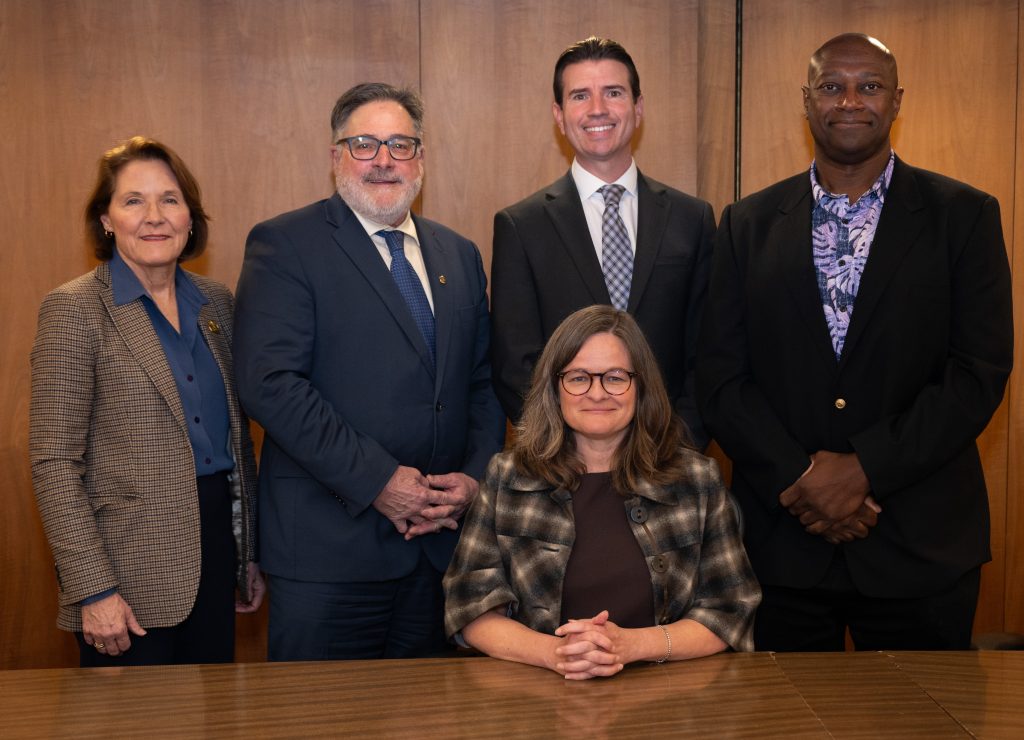
The Marin County Board of Supervisors members are (from left, standing) District 3's Stephanie Moulton-Peters, District 4's Dennis Rodoni, District 5's Eric Lucan, District 2's Brian Colbert, and (seated) District 1's Mary Sackett, who is serving as Board President for 2025.

The Marin County Board of Supervisors members are (from left, standing) District 3’s Stephanie Moulton-Peters, District 4’s Dennis Rodoni, District 5’s Eric Lucan, District 2’s Brian Colbert, and (seated) District 1’s Mary Sackett, who is serving as Board President for 2025.

The ceremony included Colbert taking his public oath of office, administered by his daughter. There were also celebratory elements such as a performance by gospel singers from his district.

Supervisor Colbert’s swearing-in is a milestone for Marin County, as he is the first African American elected to the Board since its inception in 1852.

The Board typically meets two or three times a month on Tuesday mornings in the Board chamber of the Marin County Civic Center, Suite 330 in San Rafael. Meetings are conducted both in person at the chamber and also via videoconference to increase public engagement opportunities.

Meeting start times are usually 9 AM. All Board meetings are televised live on channel 27 for Marin County subscribers of Comcast/Xfinity and streamed live on MarinCounty.gov. Videos and agendas of the meetings dating to 2005 are archived on the website as well.

“We have a collaborative Board of Supervisors that is grounded in finding solutions for the good of our constituents, the County overall, and the health of our planet,” Sackett said during her opening remarks Tuesday. “I am focused on the County delivering essential services efficiently and effectively.”

Continue Reading

Subscribe to receive news and updates from the Oakland Post

* indicates required

CHECK OUT THE LATEST ISSUE OF THE OAKLAND POST

ADVERTISEMENT

WORK FROM HOME

Home-based business with potential monthly income of $10K+ per month. A proven training system and website provided to maximize business effectiveness. Perfect job to earn side and primary income. Contact Lynne for more details: Lynne4npusa@gmail.com 800-334-0540

Facebook

Trending

Copyright ©2021 Post News Group, Inc. All Rights Reserved.