
Education
Construction Chief Tim White Pushed Out of Oakland Unified

Interim Replacement Heads Company Found Guilty of Bribery in San Diego
The new administration of the Oakland Unified School District (OUSD) seems to be in a rush to replace the widely respected, longtime head of the district’s facilities maintenance and construction department, Timothy White, although White has not resigned from his position.
<p>
After the Berkeley Unified School District contacted OUSD seeking a reference, OUSD Supt. Antwan Wilson on Friday sent out an email to staff:
“I want to announce that Timothy White, Deputy Chief of Facilities, Planning and Management, has resigned to accept a position as Executive Director of Facilities in the Berkeley Unified School District.”
On Tuesday, Supt. Wilson announced White’s replacement: “OUSD is pleased to announce that Lance Jackson, Chief Operating Officer of the Seville Group, Inc. (SGI), has agreed to become interim leader of the Oakland Unified School District’s Facilities Planning and Management Department. Jackson will serve in this role pending the search and selection of a new Deputy Chief for Facilities Planning and Management.”
Under OUSD board policy, employees must submit a resignation in writing to be official. As of Thursday afternoon, White confirmed that he had not resigned and had not accepted employment at Berkeley Unified.
In the 14 years that Tim White worked for the school district, he was in charge of expenditures for school bond Measure J, $475 million; Measure B, $35 million; Measure A, $330 million; and before that Measure C, $169 million. He also brought in $300 million in state matching funds.
White said the issue that ultimately led to him being pushed out was his refusal to have his name associated with the school district’s “community engagement process” surrounding the development and possible sale of the old district headquarters at 1025 Second Ave.
“A board member said the whole community process had been a ‘boondoggle,” White said, and the process was supposed to “reset” under White’s leadership and the leadership of his staff.
But it turned out that the changes were only cosmetic, and he was not willing to have his name and reputation associated with them.
“I didn’t want to be associated with certain outcomes that I saw developing,” he said.
Seville Group, Inc. currently has a limited role in OUSD, providing program and project management services for the District’s Measures B and J bond and capital projects.
Several of the owners of Seville Group were recently found guilty in a San Diego corruption case that involved bribing school board officials and administrators. The case resulted in across-the-board guilty pleas, jail time, community service, home detention and fines.
According to the Office of the District Attorney in San Diego, 18 defendants connected to three school districts including Sweetwater Union High School District, Southwestern College and the San Ysidro School District – “who included administrators, trustees and contractors – were originally indicted by a grand jury in December 2012 on multiple counts including bribery, perjury, filing a false instrument, influencing an elected official and obtaining something of value to influence a member of a legislative body.”
Three of the defendants, who pleaded guilty to misdemeanors, were Henry Amigable, a former employee of Seville Construction Services; Renee Flores, an owner of SGI; and Jeff Flores, also an owner of SGI.
“For years, public officials regularly accepted what amounted to bribes in exchange for their votes on multi-million dollar construction projects. The public corruption was nothing short of systemic,” said San Diego County District Attorney Bonnie M. Dumanis.
According to the Bloomberg Business website, Lance Jackson was not CEO at the time he was listed on the website but was in charge of oversight of all of SGI’s programs and projects. He had been with Seville Group since May 2002.
The Seville Group, Inc., founded in 1994, provides program, project, and construction management services for public agencies in California. Its projects include facilities, such as K-12, higher education, and municipal facilities; infrastructure projects, including water, wastewater, power, and highway projects; and transportation projects.
According to OUSD spokesman Troy Flint, White may “maintain” that he has not resigned. “But it’s a matter of public record” – it was reported at a Berkeley school board meeting that he accepted a job with Berkeley, Flint said.
“We took that as a de facto resignation, given that he has accepted employment in another organization,” Flint said.
Flint said the district is aware of the corruption case in San Diego. “That did not affect Lance Jackson in any way. He was not involved in it. That was an isolated incident…The greatest fault lies with (those) public officials.”
A phone call to Seville Group’s headquarters in Pasadena was not returned to the Oakland Post by the time the newspaper went to press.
For information on the case published by the Office of San Diego County District Attorney go to www.sdcda.org/files/South%20Bay%20Corruption%20Case%20Ends%207-2-14.pdf











Activism
How Charles R. Drew University Navigated More Than $20 Million in Fed Cuts – Still Prioritizing Students and Community Health
Named after the pioneering physician Dr. Charles R. Drew, famous for his work in blood preservation, CDU’s mission is to cultivate “diverse health professional leaders dedicated to social justice and health equity for underserved populations through education, research, clinical service, and, above all, community engagement.”
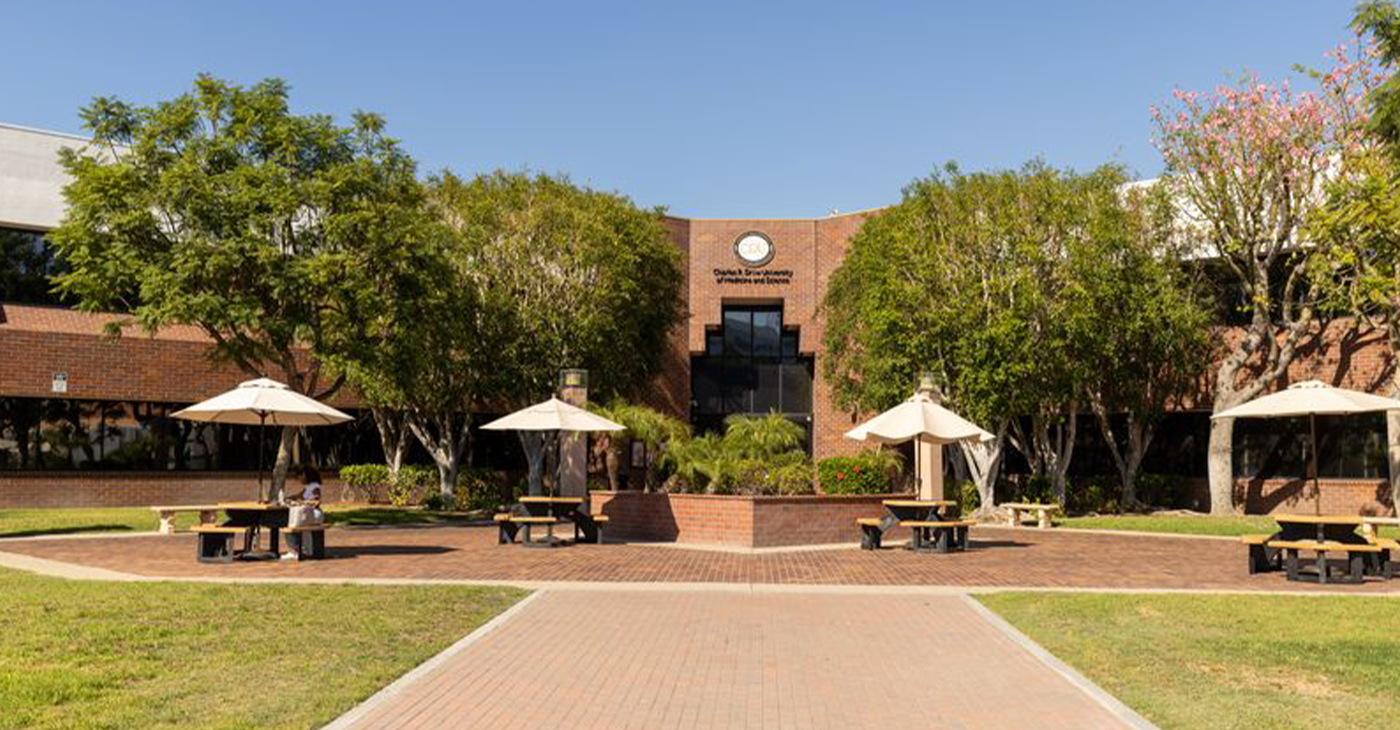
Charlene Muhammad | California Black Media

Earlier this year, when the federal government slashed more than $20 million in grants to Charles R. Drew University of Medicine and Science (CDU), the leadership of California’s only historically Black medical school scrambled to stabilize its finances — while protecting its staff and students.
Named after the pioneering physician Dr. Charles R. Drew, famous for his work in blood preservation, CDU’s mission is to cultivate “diverse health professional leaders dedicated to social justice and health equity for underserved populations through education, research, clinical service, and, above all, community engagement.”
The school is widely recognized as a vital pipeline for Black doctors and other health professionals throughout California.

Dr. David Carlisle (center), President of Charles R. Drew University of Medicine and Science (CDU), with two of the university’s students. Photo Courtesy of Charles R. Drew University of Medicine and Science.
Dr. Jose Torres-Ruiz, CDU’s Executive Vice President for Academic Affairs and Provost, said the university—designated as a Historically Black Graduate Institution (HBGI)—was notified in early March 2025 that most of its major grants, including the Research Centers in Minority Institutions (RCMI) award, known at CDU as the “Accelerating Excellence in Translational Science” (AXIS Grant), would be terminated. Initially renewed, the grant was later revoked because its language did not align with the current federal administration’s priorities.

The AXIS Grant provides $4.5 million per year for five years through the National Institutes of Health’s National Institute on Minority Health and Health Disparities. CDU quickly reallocated other funds to protect its scientists, staff, and technicians, though some personnel losses were unavoidable.
“We didn’t want to fire them because these people have expertise that takes years to gain,” Torres-Ruiz said.
The grant is crucial, he added, funding research in cancer, diabetes, and metabolic diseases that affect the Willowbrook community in South Los Angeles, training the next generation of scientists, and supporting community outreach.
Programs at the school, including its youth and teen mentoring programs reach beyond the walls of the university, impacting the lives and quality of health care of people in the surrounding community, one of the most underserved areas in Los Angeles County.
Confronted with the harsh reality of funding cuts, the university’s leadership made an early, strategic choice to honor its foundational commitment and prioritize its students. Dr. Deborah Prothrow-Stith, dean of CDU’s College of Medicine, highlighted the school’s deliberate focus on admitting students from economically disadvantaged backgrounds — many of whom are Pell Grant recipients and graduates of public high schools.
“We are staying true to our mission, finding creative ways to prioritize what’s most important,” she said. “I’m optimistic because of our students—they are dedicated and committed to service.”
In addition, the $2 million-per-year John Lewis NIMHD Research Endowment Program, intended to strengthen CDU’s research infrastructure, was terminated with three years remaining after a February 2025 freeze on nearly all federal grants for public health, education, and infrastructure projects.
Following an appeal, CDU learned in June that the RCMI grant had been fully reinstated, along with all but eight smaller grants. The university’s next priority is restoring the John Lewis Endowment.
“We are working with NIH staff to adjust the language. Certain words like ‘diversity’ and ‘equity,’ which are core values of our institution, are now under scrutiny,” Torres-Ruiz explained.
CDU has also expanded funding sources by targeting foundations and private donors. “This may happen again. We cannot rely solely on federal agencies,” Torres-Ruiz said, emphasizing the importance of building relationships with politicians and private partners.
Prothrow Stith echoed Ruiz’s perspective on cultivating multiple funding sources. “Building bridges with private foundations helps, but it doesn’t erase the disruption,” she said.
Many students rely on federal loans, CDU leaders say. Those loans are now capped at $150,000. So, most medical students graduate with $300,000–$350,000 in debt when accounting for tuition and living expenses.
To lower the burden on students, CDU is exploring options to make education more affordable, including overlapping school years to reduce annual costs.
Students like Isaiah Hoffman and Bailey Moore epitomize CDU’s values.
Hoffman, an aspiring orthopedic surgeon from Inglewood, credits Drew for inspiring his career choice. Out of 12 medical school acceptances, he chose CDU to give back to his community and continue Drew’s legacy. Hoffman also founded H.O.M.I.E.S. Inc., a nonprofit pairing Black K–12 students with mentors to support academic and personal growth.
Moore, 23, from Southeast Washington, D.C., pursued CDU to address maternal health disparities she observed in her own community – an underserved area of the nation’s capital city. “CDU pours into you. It emphasizes service, and I hope for a world without health disparities,” she said. “Drew may be small, but Drew is mighty. It was created out of necessity to save lives and empower communities.”
CDU President and CEO Dr. David Carlisle acknowledged during the Aug. 28 “State of the University” that the institution faces ongoing challenges. Political threats and grant disruptions contributed to a sizable unrestricted budget deficit, despite achievements over the past year.
Successful appeals and alternative sources of funding, led by Vice Provost Dr. Ali Andallibi, have now restored all the monies previously lost in research funding, he said.
Carlisle expressed gratitude to L.A. Care Health Plan and Sutter Health for providing multimillion-dollar scholarships and highlighted that CDU would welcome approximately 1,050 incoming students—near its highest enrollment ever. “I’m deeply grateful for the resolve, diligence, and unwavering commitment of everyone here, even when the path is not easy,” he said.
At the gathering, Carlisle referred to the sounds of ambulances passing by with blaring sirens as- the “music of healthcare,” while students and the school’s leadership attending expressed resilience in their speeches and conversations. The activities of the day captured the institution’s focus on education, service and advancing health care across disadvantaged communities in California – and beyond.
Video Report: How Charles Drew Stayed Strong Amid Federal Funding Cuts
Activism
Oakland School Board Proposes Budget Solutions to Avoid State or County Takeover
After 22 years, OUSD was finally released from state receivership in July. Facing a new deficit, the district is now urgently dealing with the threat of a new state or county takeover.

Teachers’ union calls for spending plan that prioritizes classrooms and student services
By Post Staff
Seeking to avoid the threat of a state or county takeover of the Oakland Unified School District, the Board of Education has adopted recommendations designed to provide guidelines to the superintendent and administration to resolve an ongoing budget deficit for this year and the next two years.
A resolution on budget guidance was approved at the Oct. 8 board meeting by board members Rachel Latta, Jennifer Brouhard, VanCedric Williams, and Valarie Bachelor. Voting ‘no’ were board members Mike Hutchinson, Patrice Berry, and Clifford Thompson.
After 22 years, OUSD was finally released from state receivership in July. Facing a new deficit, the district is now urgently dealing with the threat of a new state or county takeover.
The board resolution passed at the Oct. 8 board meeting directs Supt. Denise Saddler and her administration to implement a hiring freeze and review openings for new positions. Other possible savings include freezing or canceling consulting contracts, reducing travel expenses, and consolidating other purchases.
Whatever the district decides, none of the possibilities will include school closures or mergers, according to the board resolution.
District staff is expected to come back in November with budget proposals for the 2026-27 school year, including restructuring the central office, reducing administrative positions, and cutting spending on consulting contracts, as well as ways to increase enrollment.

Speaking at the board meeting, Saddler said, “What I need from all of you is to hear what the parameters are of what you would like staff to look at so we can do our best work to bring you options.”
“I want to respect that every single one of you has been doing some thinking about this and writing about it and have amendments and proposals,” she continued. “I urge you to give us the outside of the puzzle so we can go forth and do our best work.”
In an interview with the Oakland Post, Williams explained that a new board was elected last November and started in January. The board approved cuts in March of over $100 million to exit state receivership. And additional cuts of $60-$80 million are requested for 2026-2027, “which means up to $180 million within a year cycle, about 20% of the annual budget, raising the risk of returning to state receivership,” he said.
According to Williams the district carried high deficits with layoffs in 2020-21, 2021-22, and 2022-23, and prior boards “kicked the can down the road” rather than dealing with the deficits.
Past board presidents Sam Davis, Mike Hutchinson, Gary Yee, and Shanthi Gonzales “did not address the problems, leaving the current board to solve them,” he said.
Further, Willliams said, Alameda County Supt. of Schools Alysse Castro and the state agency, Fiscal Crisis Management and Assistance Team (FCMAT) “gave qualified budget approvals for four years. They could have (halted) raises or spending but did not, expecting eventual cuts without mandating immediate reductions.”
As a result, he said the “board needs to make major budget decisions this year within the next few weeks due to a looming fiscal cliff and threat of state receivership.”
“Reductions cannot come solely from central office or consultants,” Williams said. “Everything is on the table, including afterschool (programs), special education, and school restructuring.”
In a statement to the community, OUSD Chief Budget Officer Lisa Grant-Dawson wrote, “The district must develop a plan to restore its reserves as we navigate through the 2025-26 budget and prepare for the 2026-27 Budget Development process. The district will present its first Interim Report in December, reflecting its revised projections for the budget and reserves, which will then be reviewed by the County.
“As we have been saying since early in the 2024-25 school year, the District is currently deficit-spending about $4 million per month, that is, spending $4 million more every month than it’s receiving in revenues. The more we do that moving forward, the more we diminish our reserves, until, eventually, we run out of money.”
“As a school district where the mission is educating children, we cannot run out of money, and the State and County won’t let that happen,” she said. “But we need to prevent it from getting to that point in the first place. The district will need to make some very difficult choices in the near future to remain financially solvent.”
According to the Oakland Education Association (OEA), the teachers’ union, which is currently negotiating with the district for a new contract, the district traditionally distorts its budget, minimizing its revenue and maximizing its expenses to avoid increasing employee wages.
In a presentation to teachers and families, OEA President Kampala Taiz-Rancifer said, “The City of Oakland has a long history of standing up for the most marginalized in our community. And we need OUSD to stand up and be a part of protecting Oakland students by really investing in our school sites.”
Continuing, she said, “Our main job in this district is to teach children, and we need OUSD to change its priorities from (spending its money) outsourcing, contracting out, and investing in top-level management to really providing a student-centered budget.”
“The district has spent too much on the wrong things, too much on outside contracting and on central office administration while also simultaneously having this history of under-projecting revenue,” she said.
“We have a vision for a student-centered budget that invests in our school,” Rancifer said. “We need to restructure the budget to prioritize students and staff, making a student-centered budget that invests in classrooms and student services.”
According to OEA, “OUSD receives nearly $1 billion yearly to fund our schools — yet only 56% of that goes to student-facing staff. Our students feel the daily impact through high teacher- and support staff- turnover. Districts like San Diego Unified prove it’s possible to do better, investing 80% of funds directly into the people who serve students.”
Activism
California Teachers Association Rallies Behind Prop. 50: A Stand for Education and Democracy
“The dysfunction we’re witnessing in Washington, D.C. has profound implications for our schools,” Jones explained. She emphasized that the dismantling of the federal Department of Education and the curtailing of union rights for workers are issues that inevitably trickle down to affect the students in California classrooms. “This is not a fight we chose, but it’s one we must engage in for the future of our children.”

SACRAMENTO — In a bold move reflecting the urgency of the times, the California Teachers Association (CTA) has thrown its weight behind Proposition 50, an initiative spearheaded by Governor Gavin Newsom aimed at redistricting. CTA is reaching out to California’s Black voters by activating a campaign utilizing some of the state’s legacy Black newspapers.
Prop. 50 presents an opportunity for California voters to pause and reconsider the current legislative maps that dictate representation — a reaction to a national landscape where education and voting rights are increasingly under threat. Erika Jones, the Secretary/Treasurer of the CTA pointed out that the initiative serves as a direct counter to troubling developments in states like Texas, where the political climate has grown hostile towards both educational funding and voter inclusion.
“The dysfunction we’re witnessing in Washington, D.C. has profound implications for our schools,” Jones explained. She emphasized that the dismantling of the federal Department of Education and the curtailing of union rights for workers are issues that inevitably trickle down to affect the students in California classrooms. “This is not a fight we chose, but it’s one we must engage in for the future of our children.”
Critics from within the Democratic spectrum have voiced skepticism about the ethics of using Prop. 50 as a tool against what they perceive as unethical actions from other states. However, Jones argues convincingly that the current political climate itself — marked by a wave of voter suppression tactics and the sidelining of marginalized communities — constitutes an ethical crisis that demands a robust and proactive response.

“We have to take a stand,” Jones insists. She draws parallels between the present situation and historical struggles for voting rights, reflecting on her own family’s involvement in civil rights movements. “If we don’t act now, we risk losing decades of progress.” She voiced concerns that without intervention, there could be dire consequences for marginalized students, including cuts to funding that directly supports vulnerable populations.
With more than $15 billion in federal assistance hanging in the balance, the stakes could not be higher. Jones highlighted the importance of rallying both educators and community members to mobilize against what she describes as an “unethical assault” on democracy. “We cannot simply remain isolated in California; the fight for justice and equity reverberates across the entire nation.”
As supporters of Prop. 50 intensify their outreach, Jones invites California residents to join the movement. “We’re encouraging everyone to get involved — whether by volunteering to canvas or by spreading awareness through social media.” Those interested can visit cta.org/prop50 for more information on how to engage in meaningful activism.
With only a few weeks left to vote, the CTA’s call for action resonates across communities, urging Californians to recognize not just their rights as voters, but their responsibility to advocate for the future of education in a rapidly changing political landscape. As Jones aptly puts it, “This is our fight, and we must be heard.”

WORK FROM HOME
Home-based business with potential monthly income of $10K+ per month. A proven training system and website provided to maximize business effectiveness. Perfect job to earn side and primary income. Contact Lynne for more details: Lynne4npusa@gmail.com 800-334-0540


Seth Curry Makes Impressive Debut with the Golden State Warriors

LIHEAP Funds Released After Weeks of Delay as States and the District Rush to Protect Households from the Cold

Seven Steps to Help Your Child Build Meaningful Connections

Seven Steps to Help Your Child Build Meaningful Connections

Teens Reject Today’s News as Trump Intensifies His Assault on the Press

Thanksgiving Celebrated Across the Tri-State

Breaking the Silence: Black Veterans Speak Out on PTSD and the Path to Recovery

Trinidad and Tobago – Prime Minister Confirms U.S. Marines Working on Tobago Radar System

‘Tis the Season: Festive Holiday Pop-ups Happening Around Atlanta

IN MEMORIAM: Mardelle Walker, 101

Oakland Post: Week of November 26 – December 2, 2025

‘Targeted’ Shooting of Two National Guardsmen Blocks From the White House

Meet Roxanne Brown, The First African American And The First Woman President Of The United Steelworkers

Tax Refunds Expected to Rise by About $1,000 Next Year

CFP Rankings: Top Five Remains Unchanged; Major Decision Looms for Lane Kiffin

Oakland School Board Proposes Budget Solutions to Avoid State or County Takeover

A Call to Save Liberty Hall: Oakland’s Beacon of Black Heritage Faces an Uncertain Future

Port of Oakland September Cargo Volumes Dip Amid Shifting Trade Patterns

Oakland Post: Week of October 22 – 28, 2025

Prescribing Prevention: Doctors Turn to Lifestyle, Herbs and Veggies to Protect Against Chronic Illness in Black Californians

Mayor Lee Responds to OPD Chief Floyd Mitchell’s Decision to Resign

Past, Present, Possible! Oakland Residents Invited to Reimagine the 980 Freeway

Oakland Post: Week of October 29 – November 4, 2025

California Teachers Association Rallies Behind Prop. 50: A Stand for Education and Democracy

Man Arrested for Making Death Threats Against Mayor Barbara Lee

Essay: Intentional Self Care and Community Connections Can Improve Our Wellbeing

Oakland Post: Week of November 12 – 18, 2025

Oakland Post: Week of November 5 – 11, 2025

MLK Way at 57th Street in Oakland Renamed Bobby Seale Way for Black Panther Co-Founder

IN MEMORIAM: William ‘Bill’ Patterson, 94

Hyundai Ioniq 5 Parking, Safety, and 360 View #shorts

2025 Ioniq 5 New Wiper & Powerful Performance! #shorts

Electric SUV Range: Is 259 Miles Enough? #shorts

EV Charging: How Fast Can You Charge an Electric Vehicle? #shorts

Biometric Cooling… Messaging Seats…Come on! 2025 Infiniti QX80 Autograph 4WD

Charged Up: Witness the Magic of a Fully Electric Car! #shorts

Range Rover Sport PHEV Included…: See What’s Inside This Luxury SUV! #shorts

Invisible Hood View: Perfect Parking with X-Ray Vision! #shorts

AI Is Reshaping Black Healthcare: Promise, Peril, and the Push for Improved Results in California

ESSAY: Technology and Medicine, a Primary Care Point of View

Sanctuary Cities

The RESISTANCE – FREEDOM NOW

STATE OF THE PEOPLE: Freddie

ECONOMIC BOYCOTT DAY!!!!!

I told You So

-
 Activism3 weeks ago
Oakland Post: Week of November 12 – 18, 2025
-
 Activism4 weeks ago
Oakland Post: Week of November 5 – 11, 2025
-
 Activism2 weeks ago
IN MEMORIAM: William ‘Bill’ Patterson, 94
-

 Activism3 weeks ago
How Charles R. Drew University Navigated More Than $20 Million in Fed Cuts – Still Prioritizing Students and Community Health
-

 #NNPA BlackPress3 weeks ago
The Perfumed Hand of Hypocrisy: Trump Hosted Former Terror Suspect While America Condemns a Muslim Mayor
-

 Bay Area3 weeks ago
No Justice in the Justice System
-

 #NNPA BlackPress3 weeks ago
Protecting Pedophiles: The GOP’s Warped Crusade Against Its Own Lies
-

 #NNPA BlackPress2 weeks ago
Trump’s Death Threat Rhetoric Sends Nation into Crisis
